CSSBuy Trail Shoes: Box or No-Box Shipping
CSSBuy Trail Shoes: Box or No-Box Shipping
After trail running shoes arrive at the warehouse, whether to remove the original shoe box cannot be judged solely by "which is cheaper." What really needs to be determined is: whether the shoe box has value for your purpose, how much billable volume can be reduced by removing the box, and whether the warehouse's repackaging can protect the toe, heel, and upper structure.
This article helps buyers who have already purchased trail running shoes through css-buy.org and are preparing to submit international shipping to organize a decision-making method for keeping or removing the box. It does not provide fixed shipping cost conclusions, nor does it guarantee that any packaging method can completely avoid crushing, moisture, or customs inspection. Shipping costs, optional services, route restrictions, and warehouse page fields are dynamic information and should be based on what is actually displayed in the account before submitting the package.
Verification date: September 3, 2026. This article did not receive the shoe box dimensions, packaged weight, destination country, shipping route, and real-time quotes for specific orders, so it only provides the verification process and calculation methods, and does not fabricate savings amounts.
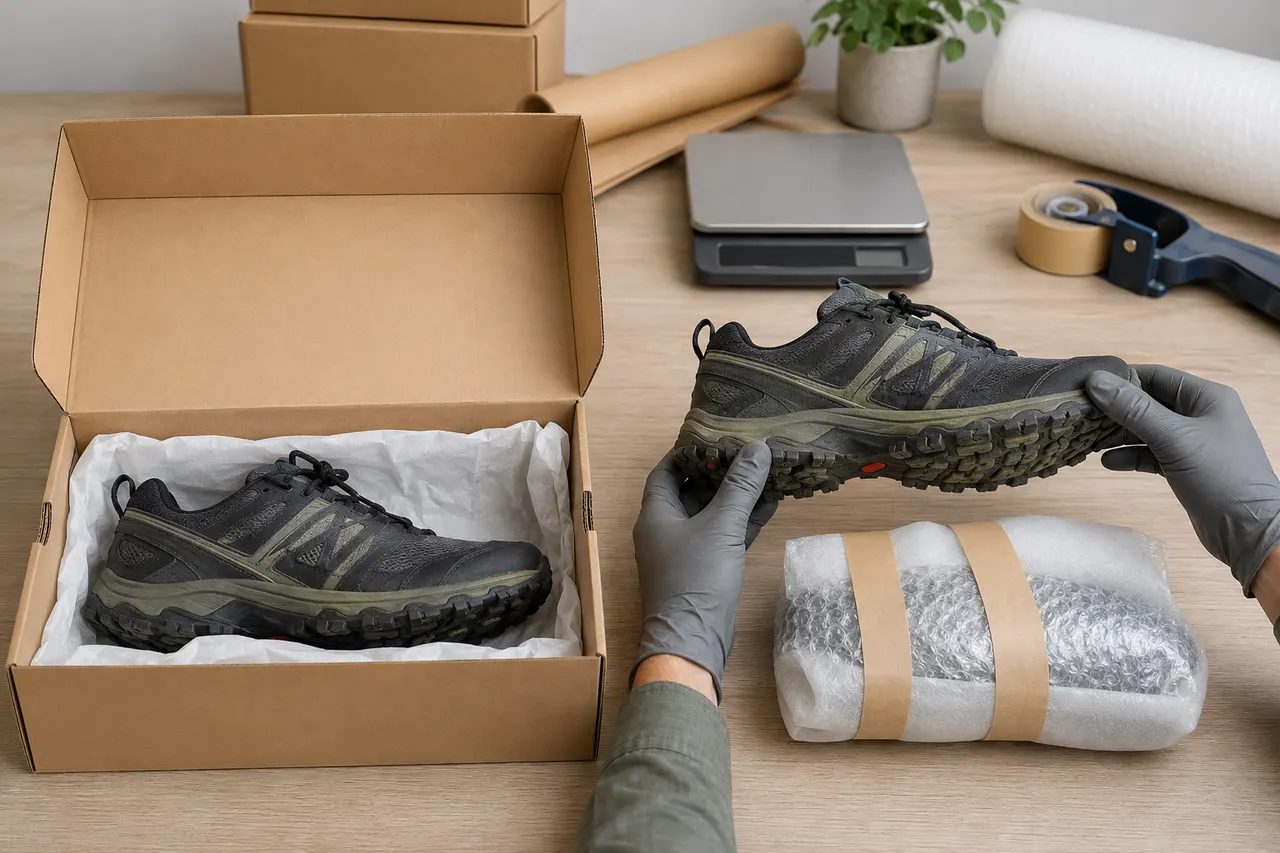
Caption: Decision illustration for shipping trail running shoes with or without the original box, does not represent specific products or actual warehouse packaging.
Clarify the Different Meanings of the Shoe Box for Personal Use, Gifting, and Collection Needs
First determine the purpose of the shoes after arrival, because the same shoe box has completely different value to different buyers.
For personal use and immediate wear, the original box is usually just shipping packaging. As long as the shoes can receive independent moisture protection, internal shoe support, and outer box compression protection, removing the box may be worth considering. Trail running shoes often have harder toe protection, outsole lugs, and some structural support, but the mesh upper, heel counter, tongue, and decorative parts may still deform under pressure.
For gifting, a complete shoe box affects the unboxing impression. Minor corner crushing or label damage may not affect the use of the shoes, but may reduce the completeness of the gift. If the recipient values the original packaging, you should prioritize keeping the box and clearly request protection of the shoe box's appearance, not just "don't throw away the box." 🎁
For collection, resale, or version verification, the shoe box label, size label, style number, color information, and barcode may have identification value. In this case, it is not advisable to remove the box just for an expected decrease in shipping cost. Even if you choose to remove the box, you should first ask for clear photos of the labels and confirm whether labels or removable identification materials can be kept with the shoes.
The following situations are not suitable for directly applying the conclusions of this article: the shoe box itself is limited-edition packaging, the product contains fragile accessories, the seller has fixed multiple parts inside the box, the destination route has special packaging requirements, or the warehouse has not yet provided photos sufficient to identify the product condition.
What Can cssbuy Warehouse Information Confirm, and What Uncertainties Exist in Shipping Outcomes
After purchasing through css-buy.org, you should treat the platform page as a verification entry for order and warehouse information, not interpret the page status as a final shipping guarantee. Buyers should check the photos, weight, dimensions, product remarks, optional value-added services, route restrictions, and quotes actually displayed for the current order on the warehouse or package-related pages. If a certain field is not displayed, do not fill in or guess based on experiences from other orders.
Warehouse photos usually only support judgments within the visible range, such as whether both left and right shoes are present, whether the color is obviously wrong, whether the size label can be seen clearly, whether there is visible dirt on the upper, and whether the shoe box is severely damaged. Photos cannot prove that there are no flaws in hidden positions, nor can they verify moisture resistance, adhesive strength, wearing comfort, or authenticity after long-term shipping.
Even if the warehouse records weight and dimensions, the final result may still be affected by repackaging, carrier re-measurement, volumetric weight rules, route billing methods, and destination country processing procedures. 📦 Therefore, the comparison between keeping and removing the box should use actual data under the same order, same destination, and same route conditions. Do not directly subtract quotes from different times, different routes, or other people's data.
Compare the Protection Focus of Keeping the Original Box vs. Removing the Box
The main advantage of keeping the original box is maintaining independent space for the shoes and reducing the chance of other items directly pressing on the upper. It can also centrally store hang tags, spare laces, instruction cards, and small accessories. However, a thin cardboard shoe box is not equivalent to a shipping-grade outer box; the original box may still be crushed at corners, affected by moisture, or move inside the outer box.
If keeping the box, you should focus on confirming:
Whether the original shoe box is already damaged, damp, or noticeably deformed
Whether an appropriate shipping outer box will be used outside the shoe box
Whether filling is needed between the shoe box and outer box to prevent shaking
Whether paper stuffing is kept inside the shoes or support that does not damage the upper is added
Whether easily detached accessories are individually bagged and secured
The main advantage of removing the box is the opportunity to reduce the space occupied by outer packaging, but the shoes lose an independent layer of support. When repackaging, you should protect the toe, heel counter, mesh upper, lace eyelets, and outsole lugs, and avoid the outsole of one shoe directly rubbing against the upper of the other.
If removing the box, you should give clear result-oriented instructions, such as "Wrap each shoe separately, keep support inside the shoes, bag accessories separately, then place in a shipping outer box." Writing only "reinforced packaging" is too vague, and the warehouse may not understand whether you are most concerned about crushing, moisture, or accessory loss. 🥾
Check Shoe Box Dimensions, Package Volume, and Billing Information Boundaries
Whether it is worth removing the shoe box must be judged using actual measurements and quotes. You need to record at least four sets of data: the weight and length, width, height of the shoes with the original box; the estimated or measured weight and dimensions after removing the box and repackaging; the billing rules of the selected route; and the payable amounts for both options under the same conditions.
If the route charges by actual weight, the benefit of removing the box may mainly come from the weight change of the cardboard box and filling materials. If the route compares actual weight and volumetric weight and takes the higher value, reducing the outer box size may be more important. The divisor for volumetric weight, rounding method, dimension measurement method, and surcharges are not fixed universal values and must be confirmed from the route rules displayed when submitting the package.
You can record as follows, and do not assume that removing the box will definitely save money:
Total cost with box = product-related costs + packaging and international shipping costs shown for the box-keeping option
Total cost without box = product-related costs + removal or repackaging service fee + international shipping cost shown for the no-box option
Verifiable savings = final quote with box - final quote without box
Volume change = packaging volume with box - packaging volume without box
Only when both options have comparable quotes can you fill in the specific savings amount. If the platform only provides an estimate for one option, you should mark the result as "pending re-measurement" and cannot write the estimated difference as already saved costs. 💰
Consolidated shipping also needs separate judgment. Removing multiple shoe boxes may reduce repeated occupied space, but may form a larger single package, increasing volumetric weight, total package value, or single loss impact. Splitting packages may increase fixed costs but sometimes better meets route size or weight limits. You should calculate based on the current package sample, not use a blanket conclusion of "always consolidate" or "always split."
What Labels, Accessories, and Product Identification Evidence Should Be Kept After Removing the Box
Before confirming removal of the box, first distinguish between "discarding the cardboard box" and "discarding all items inside the box." It is recommended to check item by item and specify in the instructions:
Size labels on the tongue or inside the shoe
Photos of the style number, size, color, and barcode labels on the original shoe box
Hang tags, spare laces, instruction cards, and included accessories
Warehouse photos showing left and right shoes, soles, toes, heels, and main appearance
Original photos and order records for after-sales communication when visible issues are found
If the box label serves an important identification role, you can ask the warehouse whether they can take clear photos before removing the box, or keep removable labels without violating platform operation requirements. Do not assume the warehouse can cut off labels, and do not request damaging the product itself.
When saving evidence, you should cover names, addresses, phone numbers, order numbers, payment information, and complete waybills. When consulting publicly, only provide the partial information necessary to judge the issue, and do not upload complete account pages. 🔒
Use a Comparison Table to Record Compression, Moisture, Volume, and Verification Needs
The following table is used to record the actual status before submitting the package. "Better" or "Lower" only indicates usual structural differences and does not represent specific warehouse operations or carrier results.
Check Item | Keep Original Shoe Box | Remove Original Shoe Box | Need to Confirm Before Ordering |
|---|---|---|---|
Upper and heel compression protection | One extra layer of independent space, but thin shoe box may still deform | More dependent on internal shoe support, separate wrapping, and shipping outer box | Can the warehouse provide clear compression protection packaging |
Moisture | Shoe box can isolate slight contact, but cardboard itself is moisture-prone | Can reduce damp cardboard, but shoes still need moisture protection packaging | Selected packaging materials and route conditions |
Package volume | Usually takes more space | May be reduced, but based on repacked dimensions | Length, width, height and billing rules for both options |
Product identification | Shoe box label easier to retain | Need to save label photos and accessories in advance | Are style number, size, color information clear |
Gifting or collection | Completeness usually higher | Original packaging value cannot be restored | Does recipient care about original box condition |
Risk focus | Shoe box crushing, volume increase | Shoe body compression, missing accessories or labels | Which loss is harder to accept for current purpose |
When filling out this table, it is best to keep "unknown" as is. Unknown items mean you need to verify with the platform, not choose an answer that sounds more convenient.
Check Optional Services and Final Instructions Before Submitting Packaging Requirements
Before submitting a package on css-buy.org, reopen the current order and package page to check whether optional services, fees, restrictions, and remark entry are still available. Platform pages and logistics conditions may change, and earlier screenshots cannot replace the information on the day of submission.
Final instructions should be brief, executable, and prioritized. The no-box option can be written as: Remove the paper shoe box; keep both shoes, all hang tags, spare laces, and accessories; wrap each shoe separately; add support inside the shoes that does not damage the upper; protect the toe and heel; record package weight and dimensions after completion.
The box-keeping option can be written as: Keep the original shoe box and all accessories inside; protect the four corners of the shoe box; place the shoe box in a shipping outer box; fill gaps appropriately; do not stick the international waybill directly on the product shoe box; record weight and dimensions after completion.
Before submission, check five things again:
Does the instruction clearly state keep or remove the box
Are labels, hang tags, and accessories specified separately for retention scope
Are compression and moisture requirements specific to toe, heel, and upper
Are packaging service fees and route quotes displayed and recorded
After final package data changes, do you need to re-compare routes
If the platform does not provide a certain service or cannot confirm whether instructions are executable, you should keep the original packaging first and wait until information is clear before submitting. Removing the box is usually irreversible and not suitable for hasty operation before critical verification is completed.
Determine Box-Keeping or Box-Removal Plan Based on Purpose
If for personal use, the original shoe box has no collection value, the warehouse has completed necessary verification, and the measured dimensions after removing the box and same-route quote have indeed decreased, you can consider removing the box. Buyers suitable for this option usually value shipping efficiency more and are willing to manage compression risk through internal shoe support, separate wrapping, and shipping outer box.
For gifting, collection, possible resale, needing box labels to identify versions, or when the price difference between the two options is very small, keeping the box is safer. If the shoe box is already visibly damaged, do not automatically assume removing the box is better; first judge whether labels, accessories, and after-sales evidence have been completely preserved.
The final decision should also record four results:
Savings amount: Only fill in the difference between two final quotes on the same route; if no dual quotes currently, mark as pending verification
Increased risk: Removing the box mainly increases risk of shoe body compression, missing labels or accessories; keeping the box mainly increases volume and risk of shoe box crushing
Applicable people: Box removal is more suitable for personal-use buyers who value shipping cost and volume; box keeping is more suitable for buyers who value packaging completeness and identification evidence
Conditions not recommended: When quote difference is unconfirmed, warehouse photos are insufficient, accessories have not been counted, original box has collection value, or platform cannot confirm repackaging requirements, removing the box is not recommended
The most reliable choice is not "keeping the box is definitely safe" or "removing the box definitely saves money," but allowing purpose, warehouse evidence, packaging requirements, and same-condition quotes to jointly support the same decision. ✅
Content note: This article was generated by the automated editorial process of Panda-Buy Editorial Desk, based on verifiable boundaries for risk and decision organization, and does not claim real-person purchase, wearing, or shipping tests. Information involving orders, packaging services, routes, fees, and policies should be re-confirmed through the actual pages of css-buy.org on the day of package submission.
Agent Platform Shopping FAQ
1. How can I find a product I want to buy on css-buy.org?
To search for items on css-buy.org, you can either use a single keyword or browse directly through the category page, where items are also sorted by brand. Using longer search phrases generally yields fewer outcomes compared to shorter ones, but they tend to be more accurate. For instance, you might look up "Air Force 1 White," "sneakers," or just "Air Force 1."
2. What kinds of products are available on css-buy.org?
css-buy.org provides a wide selection of product categories, including footwear, T-shirts, sweaters, hoodies, jeans, sweatpants, shorts, beach shorts, factory clearance items, down jackets, baseball jerseys, shirts, hats, jewelry, bags, electronics, sunglasses, socks, underwear, and trendy collectibles.
3. What product categories can I locate in the css-buy.org spreadsheet?
The spreadsheet available on css-buy.org includes products such as shoes, clothing, bags, accessories, jerseys, perfumes, hats, scarves, belts, and various household daily necessities.
4. For css-buy.org users: Which platform offers the best coupon deals?
Kakobuy is suggested because it currently provides a $15 discount code without a minimum purchase requirement. This deal is beneficial for users ordering small packages. The promotional code is kakobuy888.
Browse our latest products and find your next favorite item.